How to Budget as a Couple Without Fighting

Listen to this article
Why do money arguments keep happening even when both people are trying?
It’s easy to assume money fights come down to one person spending too much or one person being too controlling. Sometimes that’s true. More often, the real issue is simpler and less personal: the two of you are working from different pictures of the same finances.
One person remembers the credit card balance from a few weeks ago. The other is thinking about what’s left in checking right now. One person budgets around the next paycheck. The other is thinking about a bill due in three weeks that hasn’t come up yet. Neither person is wrong. They’re just each holding half the information, and the argument that follows usually isn’t really about the purchase in question, it’s about the surprise of finding out about it after the fact.
One person buys concert tickets assuming there’s room in the budget. The other knows the car insurance renewal is due next week. Neither person is being irresponsible, they’re just working from different information.
Or it shows up the other way. One person sees a $200 purchase and assumes it was careless. The other knows a reimbursement is arriving in a few days and already planned around it. The disagreement isn’t really about the purchase, it’s that one person had information the other didn’t.
Does combining finances automatically fix this?
Not on its own. Plenty of couples share every account and still feel out of sync, because sharing accounts isn’t the same as sharing visibility. You can have joint checking and still have no shared sense of what’s actually planned for the month, what’s already spent, or what’s coming up.
What tends to help more than account structure is a shared view both people actually look at. It doesn’t need to be complicated. It needs to be a single place where both people can see the same numbers at the same time, instead of one person holding the full picture in their head and updating the other person verbally, usually after something’s already happened.
What should a couple actually look at together?
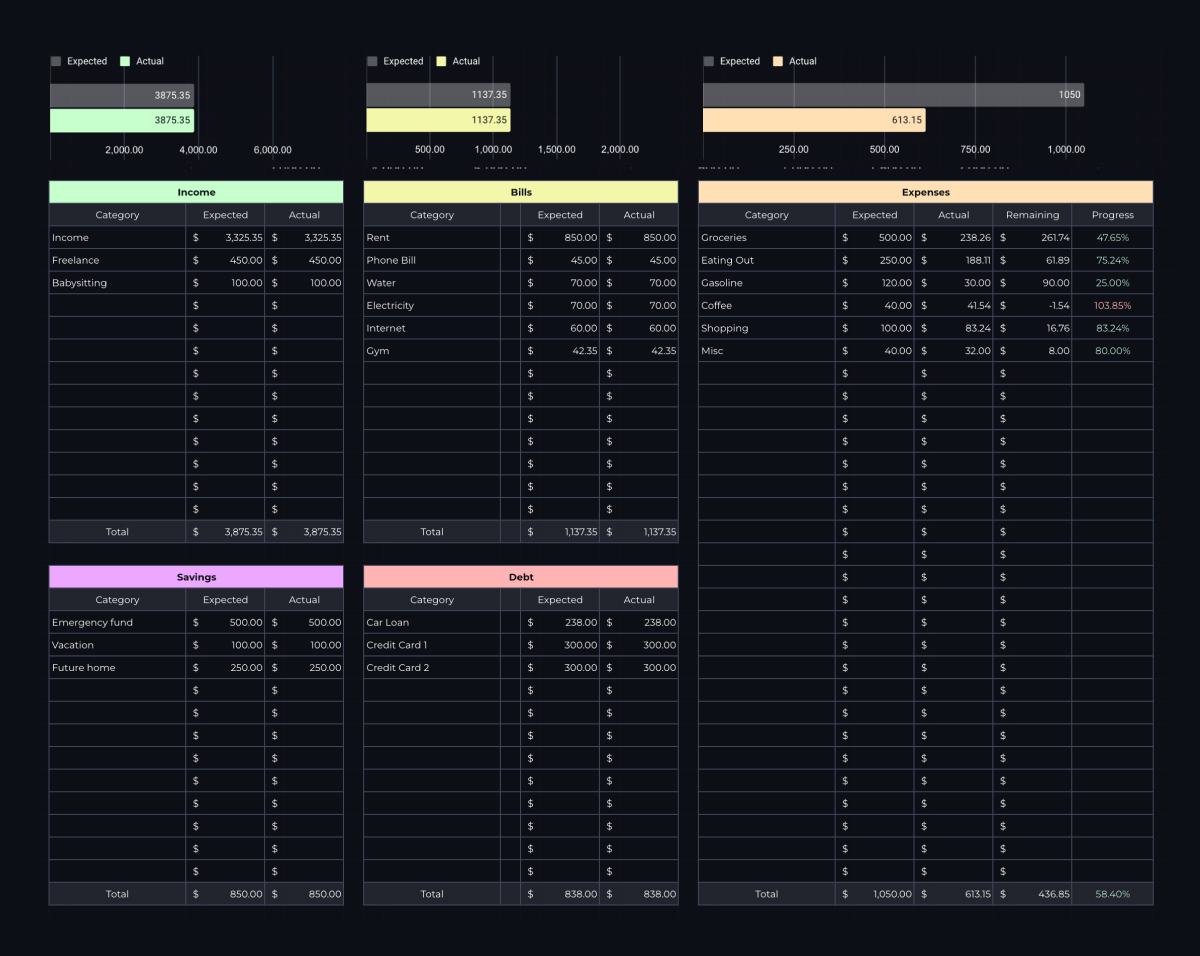
A few things tend to matter more than the rest. What’s coming in this month, from both incomes if there are two. What’s already committed to bills and fixed costs. What’s left after that, and what the plan is for it. And anything irregular on the horizon, an annual renewal, a trip, a gift, that one person might know about and the other doesn’t yet.
None of this requires a long meeting. Most couples who keep this up long term do it in short check-ins, ten or fifteen minutes every week or two, looking at the same shared numbers rather than recapping from memory. The goal isn’t a deep financial discussion every time. It’s just making sure neither person is operating on outdated information.
What if you and your partner think about money completely differently?
This is common, and it’s not actually a problem to solve, it’s something to plan around. One person might be detail-oriented and want to see every transaction. The other might want the short version: are we on track or not. A shared system can hold both. The detail-oriented person can look as closely as they want, and the other person can glance at a total and move on, as long as they’re both looking at the same source instead of two different mental versions of the budget.
If you want to put a name to why you and your partner approach money so differently, the four budgeting styles (Planner, Saver, Spender, and Avoider) usually explains it. Most friction isn’t a values mismatch, it’s two different styles trying to use the same system.
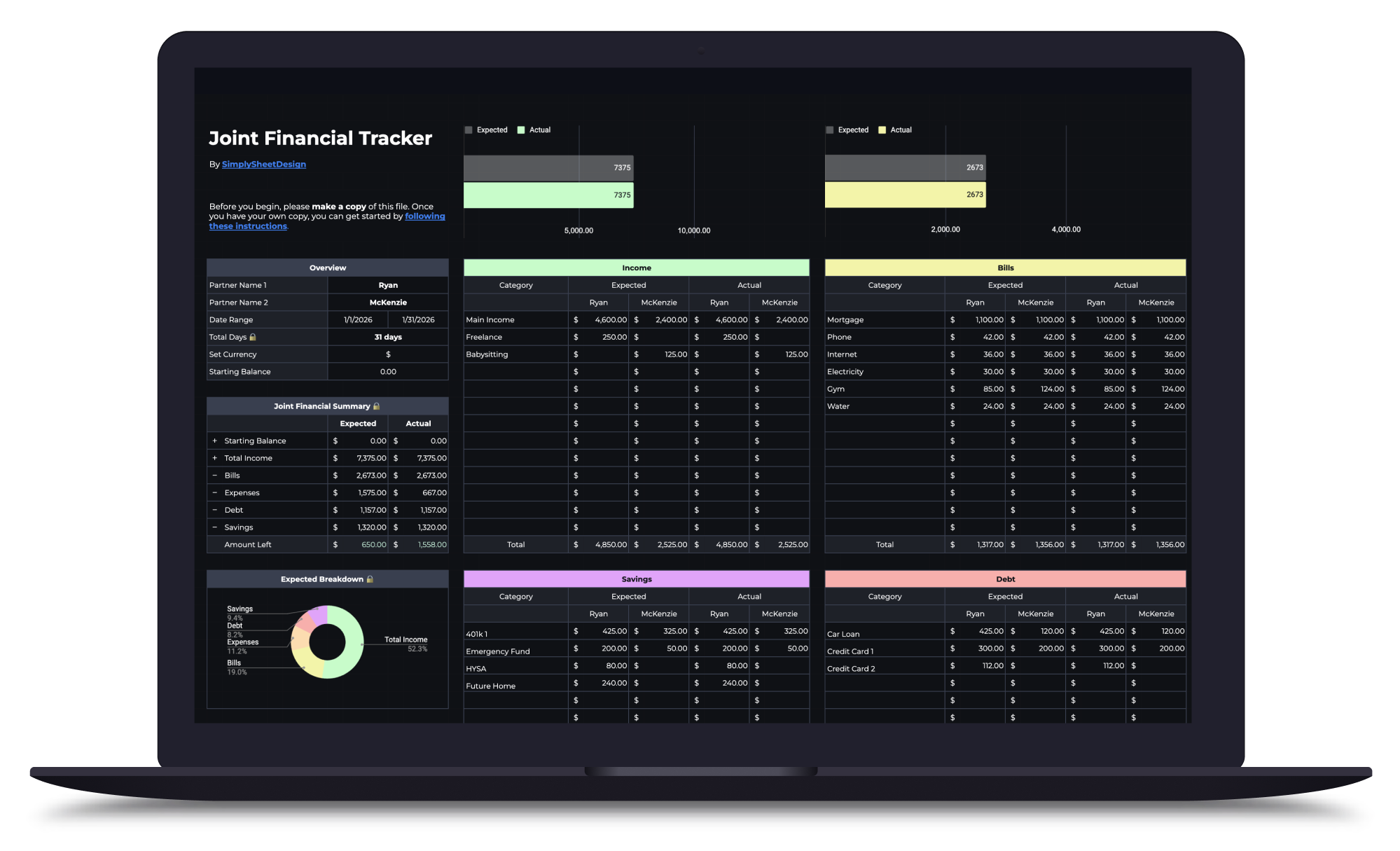
This is usually where a simple shared couples budget spreadsheet earns its place over juggling separate apps or separate mental tallies. One shared sheet means both people are reacting to the same numbers, which removes a surprising amount of the friction before it has a chance to turn into an argument.
Built for two incomes
Couples Budget Spreadsheet
Split bills, track shared and personal expenses, and manage savings together. Built for two incomes, one shared financial picture.
Should you split shared expenses evenly, or by income?
This is usually the first concrete decision underneath all the bigger conversations: when a shared bill comes due, who actually pays what? Two approaches cover most situations. An even 50/50 split divides every shared expense down the middle, no matter what each person earns. Splitting by income instead has each partner contribute the same percentage of their own paycheck, so the higher earner naturally covers a larger dollar amount.
Here’s what that looks like for a couple bringing in $4,500 and $2,500 a month, with $3,000 in shared expenses:
| Even 50/50 | Proportional | |
|---|---|---|
| Higher earner ($4,500) | $1,500 | $1,929 |
| Lower earner ($2,500) | $1,500 | $1,071 |
| Higher earner has left | $3,000 | $2,571 |
| Lower earner has left | $1,000 | $1,429 |
Notice what happens to what’s left over. With an even split, the lower earner has spent 60% of their income on shared bills before anything else, while the higher earner has spent only 33%. Splitting by income instead leaves both partners with a much closer share of their own paycheck free for savings, debt, or discretionary spending, which is usually the actual goal: neither person feels like they’re carrying a disproportionate load relative to what they bring in.
To run your own numbers, how couples split bills fairly when they earn different incomes walks through both methods in more depth and includes a bill split calculator that compares them side by side for your situation.
What’s a reasonable way to start?
Start smaller than feels necessary. Pick one shared view of income and fixed expenses for the current month, agree to look at it together once a week, and let the rest build from there. Most of the tension in couples’ finances comes from misalignment, not bad decisions, and misalignment is usually the easiest part to fix once there’s one shared place both people are actually looking at.