How Couples Split Bills Fairly When They Earn Different Incomes

Listen to this article
Most couples start out splitting the bills straight down the middle. It feels obvious and even: same rent, same utilities, so pay half each. That works fine when two paychecks are roughly the same size. It starts to feel off the moment they aren’t.
If one of you earns noticeably more than the other, a 50/50 split isn’t as even as it looks. The same dollar amount is a small slice of the larger paycheck and a big slice of the smaller one, so the lower earner ends up with far less money left over even though you both paid exactly the same. Splitting bills fairly when you earn different incomes usually means moving away from equal dollars and toward equal effort.
Why does a 50/50 split feel unfair when incomes are different?
Say the shared bills come to $3,000 a month. Under a 50/50 split, you each pay $1,500. Simple.
Now add the incomes. If one partner takes home $4,500 a month and the other takes home $2,500, that same $1,500 is a third of the first paycheck and well over half of the second.
| Take-home pay | Pays 50/50 | Left to live on |
|---|---|---|
| You: $4,500 | $1,500 | $3,000 |
| Partner: $2,500 | $1,500 | $1,000 |
One person has $3,000 left for everything else in their life. The other has $1,000. They paid the identical amount toward the bills, but they are not living with anything close to the same financial breathing room.
That gap is the whole problem with equal dollars. A 50/50 split treats the bills as if both people arrive at them with the same resources, and when incomes differ, they don’t. The split looks fair on the invoice and feels unfair in the bank account.
What does “splitting bills by income” actually mean?
The most common fix is to split shared bills in proportion to income instead of in equal halves. The idea is simple: each person covers the same share of the bills as they earn of the combined income.
Work it out in three steps:
- Add both take-home incomes together to get your household total.
- Find each person’s share of that total as a percentage.
- Apply that same percentage to your shared bills.
Use the same kind of number for both of you. If one partner is paid biweekly and the other monthly, convert each paycheck to monthly income before comparing, or the biweekly earner’s share will look smaller than it really is.
| Take-home pay | Share of income | Pays by income |
|---|---|---|
| You: $4,500 | 64% | $1,929 |
| Partner: $2,500 | 36% | $1,071 |
Using the numbers above, the household earns $7,000 a month. The higher earner brings in about 64% of that, the lower earner about 36%. Applied to $3,000 in bills, the higher earner pays about $1,930 and the lower earner about $1,070. Now both people are giving up the same slice of their own income, and both are left with a similar percentage to live on. The bill didn’t change. Who carries it did.
Try the bill split calculator
Rather than do this by hand, enter your own numbers below. Put in each take-home income and your total shared bills, and it shows the flat 50/50 split next to the split weighted by income, so you can see the actual difference for your situation.
Rent, utilities, groceries, and anything else you cover together. Leave out personal spending.
| Each person | 50/50 | Proportional |
|---|---|---|
| You | $0 | $0 |
| Partner | $0 | $0 |
"Proportional" splits the same bills in proportion to what each person earns, so both cover the same share of their own paycheck.
Seeing both numbers side by side is usually what makes the decision easy. If your incomes are close, the two columns barely differ and 50/50 is perfectly reasonable. If they’re far apart, the gap between the columns is often big enough that the proportional split is an easy call.
Want to come back to this later? The bill split calculator has the same tool on its own page.
50/50 vs. proportional: a worked example
Here’s the same comparison laid out fully, using take-home pay of $4,500 and $2,500 on $3,000 of shared bills.
| Even 50/50 | Proportional | |
|---|---|---|
| Higher earner ($4,500) | $1,500 | $1,929 |
| Lower earner ($2,500) | $1,500 | $1,071 |
| Higher earner has left | $3,000 | $2,571 |
| Lower earner has left | $1,000 | $1,429 |
Under the even split, the lower earner is left with a third of what the higher earner has. Under the proportional split, both are left with roughly 57% of their own take-home pay. The proportional split moves about $430 of the monthly bills from the person who feels it most to the person who feels it least, and it does that without either person dipping into a separate “his and hers” accounting fight.
Neither column is the objectively correct one. A couple that values maximum simplicity might still choose 50/50 and adjust in other ways. But you can only make that choice well once you can see both numbers.
Which bills should you actually split?
Whatever method you pick, apply it only to genuinely shared costs. Those usually include:
- Rent or mortgage
- Utilities: electricity, gas, water, internet
- Groceries and household supplies
- Home and auto insurance
- Subscriptions you both use
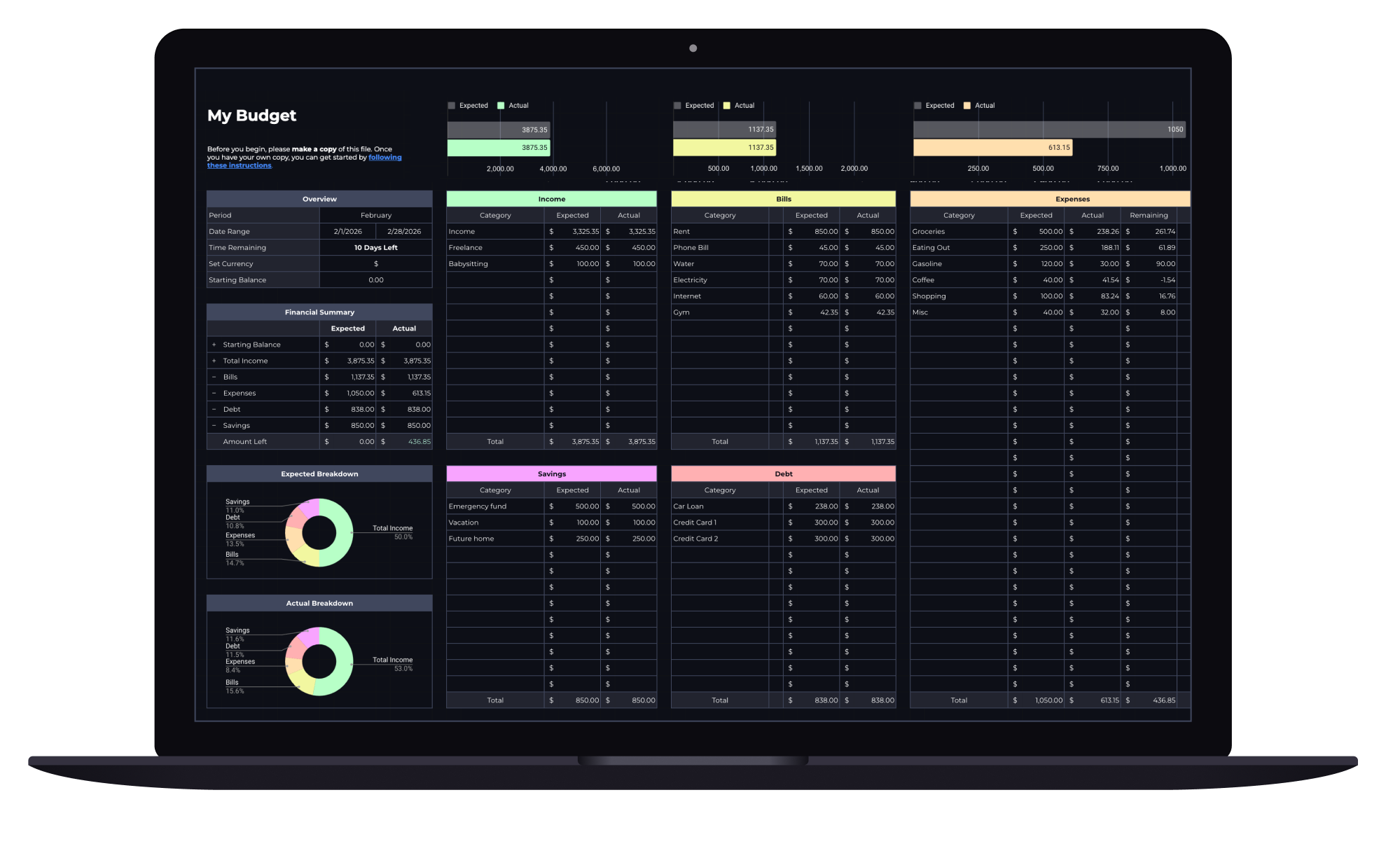
Keep personal spending out of the shared pool. Individual hobbies, solo subscriptions, gifts you buy each other, and each person’s own debt payments stay separate. The point of a fair split isn’t to merge every dollar, it’s to share the joint costs fairly while both people keep money that is clearly their own. If figuring out which expenses are joint and which are personal is the messy part, a couples budget spreadsheet that tags each expense as one partner’s or shared keeps the shared total honest without a monthly argument about it.
How do you set up the split without merging everything?
Splitting by income is just a rule for who owes what, so it works with almost any account setup.
The cleanest version for most couples is a shared bills account. Each person transfers their share into it on payday, and every joint bill is paid from there. Nobody is fronting the money or chasing the other for their half, and the account balance is a shared, visible number you can both check.
If you’d rather not open a joint account, the reimbursement approach works just as well: one person pays the bills, the other sends their portion each month. It takes a little more discipline to keep up, but the math is identical. You don’t need combined finances to split fairly, you just need to agree on the split and actually move the money.

Built for two incomes
Couples Budget Spreadsheet
Split bills, track shared and personal expenses, and manage savings together. Built for two incomes, one shared financial picture.
What if one partner still prefers to split everything evenly?
Some couples genuinely prefer 50/50, even with a gap in income, and that’s a legitimate choice. What matters is that it’s a choice you both made on purpose, with the real numbers in front of you, rather than a default nobody ever questioned.
A middle path exists too. Some couples split by disposable income: subtract each person’s essential personal costs, like their own car payment or student loan, then split the shared bills in proportion to what’s left. That can feel fairer still when the income gap is large or when one person carries debt the other doesn’t. It’s more moving parts, so most couples are better served starting with a straight income-proportional split and only reaching for something more detailed if it clearly fits their situation.
However you divide it, the split works best as a shared decision you revisit, not a rule one person sets and the other quietly resents. Couples who talk the plan through and keep looking at the same numbers tend to argue about money far less, which is really the entire goal. And if you want to understand why you and your partner instinctively approach this so differently, the four budgeting styles usually explains the friction.
The bottom line
A 50/50 split is the easy default, and when two incomes are close, it’s genuinely fair. When they’re not, splitting equal dollars quietly hands the lower earner a much tighter month for the same contribution. Splitting bills in proportion to income fixes that by asking both people for the same share of what they actually earn, so the fairness shows up where it counts, in what each person has left to live on.
Run your real numbers through the calculator above, pick the split that feels right to both of you, and put the transfers on autopilot. The fairest split is the one you both understood and agreed to, and it takes about ten minutes to set up for good.