Sinking Fund vs. Emergency Fund: What's the Difference?

Both of these are savings. Both sit in an account you are not supposed to touch for everyday spending. That similarity is why people mix them up, and mixing them up is expensive in a specific way: the emergency fund quietly becomes the account that pays for Christmas, and then there is nothing left when the water heater actually fails.
The distinction is simpler than the names suggest. A sinking fund is for an expense you can name and date. An emergency fund is for the expenses you cannot.
What is a sinking fund?
A sinking fund is money set aside a little at a time for one specific known expense. It has a target amount, a deadline, and usually a label: car registration, holiday gifts, the vet’s annual visit, a replacement laptop, a vacation in June.
The math is deliberate rather than open-ended. If the expense is $900 and it arrives in nine months, the sinking fund takes $100 a month. When the expense arrives, the money is already there, you spend it, and the fund starts filling again for next year. It is a bill you have broken into monthly pieces so it never lands all at once.
Most people already have several of these expenses. What they usually do not have is a place for the money to accumulate, which is why a predictable annual cost still manages to feel like a shock. Sinking funds fix that specific problem, and they are the reason an expense you have paid every year for a decade can stop being a crisis.
What is an emergency fund?
An emergency fund is a general reserve with no expense attached to it. You do not know what it is for. That is the entire point.
It covers the events you genuinely cannot schedule: a job ending, a medical bill, a car problem with no warning, an urgent trip you did not plan. Because there is no known target, its size is set by how much risk you are carrying rather than by a specific number, which is why the usual advice is a range of months rather than a dollar figure. How many months actually fits your situation depends on how stable your income is and how much backup you already have.
An emergency fund is also not supposed to empty and refill on a schedule. A sinking fund is meant to be spent. An emergency fund sits there, ideally for years, doing nothing visible.
What is the actual difference?
The cleanest way to separate them is to ask two questions about any expense: do you know it is coming, and do you know roughly what it will cost. If the answer to both is yes, it is a sinking fund expense.
| Sinking fund | Emergency fund | |
|---|---|---|
| What it covers | A known, named expense | Anything unpredictable |
| Timing | You know roughly when | No idea |
| Amount | A specific target | A range of months |
| Spending pattern | Fills, empties, refills | Sits untouched |
| How many | One per expense | One, total |
| Success looks like | Paying the bill without flinching | Never needing it |
The overlap that confuses people is that the same category of spending can belong to either bucket. Tires you have watched wear down for six months are a sinking fund expense. A blowout on the highway is an emergency. The category is not what decides it. The amount of warning you had is.
Which bucket does this expense belong in?
When a real expense is in front of you, the question is usually narrower than the theory: is this a sinking fund, an emergency, or just a normal line in this month’s budget. Answer five quick questions and this will tell you which one it is.
What are you saving for?
Assessment result
Do you need both?
Yes, and the reason is that each one fails in a predictable way without the other.
Without sinking funds, every annual and semi-annual expense has to come from somewhere, and the only pot of money that is not already committed is the emergency fund. So it gets raided, repeatedly, for things that were never emergencies. The balance never grows, and the one time something genuinely goes wrong, the fund has been spent on car registration and a wedding gift.
Without an emergency fund, sinking funds cover everything you anticipated and nothing you did not. The first real surprise goes on a credit card, and now a new monthly payment is competing with the sinking fund contributions that were working fine.
Running both keeps each one doing its own job. The sinking funds absorb the predictable lumps so the emergency fund is never asked to, and the emergency fund stays intact for the thing nobody scheduled.
Which should you build first?
A reasonable sequence for most people is a small starter emergency fund, then sinking funds, then the full emergency fund.
The starter fund comes first because a single unplanned expense can undo months of careful sinking fund contributions. Enough to absorb one bad surprise without borrowing is usually the right size for this stage, and it is a milestone you can reach in weeks rather than a year.
Sinking funds come next because they stop the leak. Every predictable expense you fund on purpose is one that no longer pulls from savings at the last minute. This is the step that makes the third one possible.
The full emergency fund comes last, and it grows faster than people expect once the sinking funds are handling the known costs. Most of what was draining savings was never unpredictable in the first place.
If you are trying to work out where the contributions for all of this come from, the 50/30/20 rule puts savings into one 20% slice of take-home pay, which both funds can share until the emergency fund is built.
How much goes in each?
A sinking fund has an exact answer. Total cost divided by months remaining. The sinking fund calculator will do it for a target and a date, including the weekly and biweekly equivalents if that matches how you are paid.
An emergency fund does not have an exact answer, because it is sized against uncertainty rather than a bill. The emergency fund calculator starts from your essential monthly expenses, the ones that do not stop if income does, and lets you try different coverage periods rather than handing you a single number.
Run both and you get two very different outputs: a precise monthly contribution for each sinking fund, and a target range for the emergency fund that you move toward over a much longer stretch.
Where should you keep them?
Both should be somewhere you can reach within a day or two and somewhere you will not spend by accident. A separate savings account is the usual answer for both.
Whether they live in the same account is a tracking question rather than a banking one. One account is simpler and often earns the same interest, but it only works if you know how the balance splits, because a single number tells you nothing about whether the $4,000 in there is four funded sinking funds or a real emergency reserve. Separate accounts make that boundary physical instead of something you have to remember.
Either way, the split has to be written down somewhere. A sinking funds tracker keeps each fund’s target, contributions, and current balance on one dashboard, so you can see at a glance which are full and which still need feeding. For the emergency fund and any longer-horizon goals sitting alongside it, a savings goals tracker does the same job across multiple targets at once.
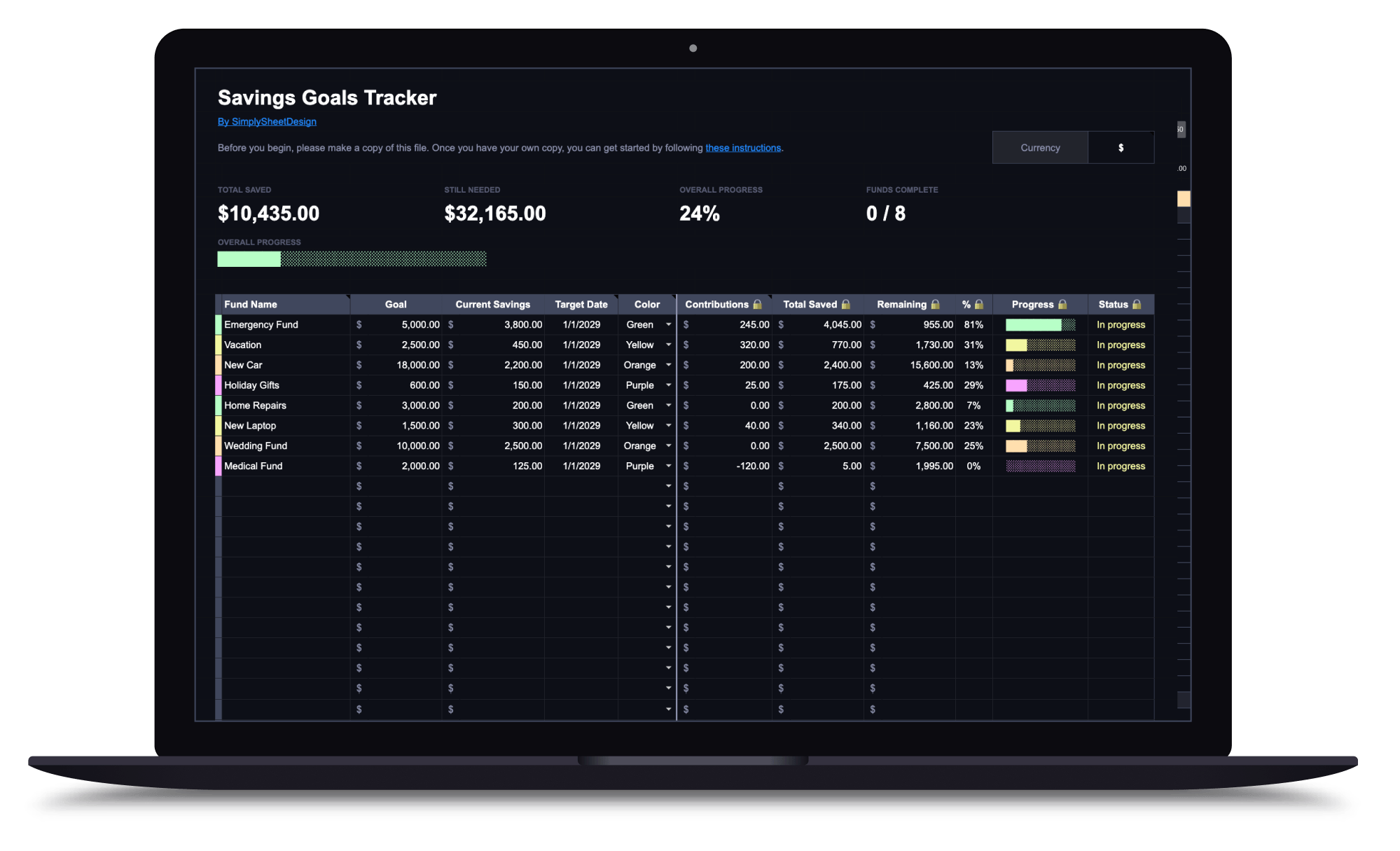
Keep each fund's balance visible
Savings Goals Tracker
Set multiple savings goals, track contributions, and watch your progress toward each one. Perfect for emergency funds, sinking funds, and any savings target.
The short version
A sinking fund is for a bill you can see coming. An emergency fund is for the ones you cannot. Running only the emergency fund means it gets spent on things that were never emergencies, and running only sinking funds means the first genuine surprise becomes debt.
The useful test is not which category an expense falls into on paper. It is how much warning you had. Everything you saw coming should have had a fund filling for it already, and everything left over is what the emergency fund is actually for.