
Sinking Fund Calculator
Enter your target amount and the month you'll need it by, and this tool calculates exactly how much to set aside each month, plus the weekly and biweekly equivalent, so the money is ready when you need it.
How this calculator works
The math is simple division: target amount split across the months between now and your deadline. What the calculator adds is the translation into per-paycheck terms, because "save $600 by June" is abstract while "$75 per paycheck" is an instruction you can act on this Friday.
Not sure the expense you have in mind belongs in a sinking fund at all? Take the sinking fund assessment first; it sorts an expense into sinking fund, emergency fund, or regular monthly budget in five questions.
What is a sinking fund?
A sinking fund is money you set aside in small, regular amounts for a specific expense you know is coming. Instead of December wrecking your budget or an annual insurance premium landing as a "surprise," the cost is already sitting in savings when it arrives, because you paid for it a little at a time.
The deeper benefit is emotional: expenses you've pre-funded stop feeling like emergencies. How sinking funds work covers why so many "emergencies" are actually predictable, and how sinking funds quietly remove them from your life.
Common sinking fund categories
The best candidates are irregular but predictable: car repairs and registration, annual or semi-annual insurance premiums, holiday gifts, travel, back-to-school costs, home maintenance, medical deductibles, and annual software or membership renewals. Anything with a known season and a rough price tag qualifies.
A good way to find yours is to scan the last twelve months of spending for the expenses that blindsided you. Most people find three or four repeat offenders immediately, and those become the first funds worth setting up.
Monthly, biweekly, or weekly contributions?
Match the contribution schedule to your paydays, not the calendar. If you're paid every two weeks, a biweekly transfer on payday is far more likely to survive than a monthly transfer that lands at the wrong point in your cash flow. The biweekly paycheck calculator helps you see which weeks have room.
Once you're running more than one fund, the challenge shifts from math to visibility: knowing what each fund is for, what's in it, and whether it's on pace. See the sinking funds tracker to keep every fund on one page so nothing quietly falls behind.
Frequently asked questions
What is the difference between a sinking fund and an emergency fund?
A sinking fund is for a known expense with a rough date and amount: car insurance, holiday gifts, a vacation, annual subscriptions. An emergency fund is for the unknown: job loss, medical bills, urgent repairs. Sinking funds exist precisely so predictable costs stop raiding your emergency savings.
How many sinking funds should I have?
Start with two or three that cover your biggest predictable annual expenses, often car costs, holidays, and travel. People comfortably run five to ten once the habit sticks. The limit is practical: each fund needs a clear purpose and a monthly contribution your budget can actually support.
Do sinking funds need separate bank accounts?
No. Plenty of people keep one savings account and track the split on paper or in a spreadsheet. Separate accounts (or a bank with built-in sub-accounts or buckets) just make the boundaries harder to blur. Use whichever version you will actually maintain.
What if I miss a month of contributions?
Recalculate rather than guilt-spiral. Enter the same target with your new remaining timeline and get the updated monthly amount. If the new number is too high, you can also push the target date out or trim the target amount. A sinking fund is a plan, and plans get revised.
What if my target date is only a couple of months away?
The calculator will show you the honest, possibly painful monthly number. If it doesn’t fit your budget, you have three levers: delay the expense, reduce the amount, or cover part of it from regular monthly spending. Knowing that now is the entire benefit of doing the math early.
More free tools
Sinking Fund Assessment
Answer 5 quick questions to find out if your expense is a good fit for a sinking fund, an emergency fund, or your regular monthly budget.
Emergency Fund Calculator
Enter your essential monthly expenses and see how much to keep saved for 3, 6, 9, or 12 months of coverage.
Biweekly Paycheck Calculator
Paid every two weeks? See your typical two-paycheck month, your two three-paycheck months, and a steady average to budget against.
50/30/20 Budget Calculator
Enter your take-home pay and see how much to spend on needs, wants, and savings each month.
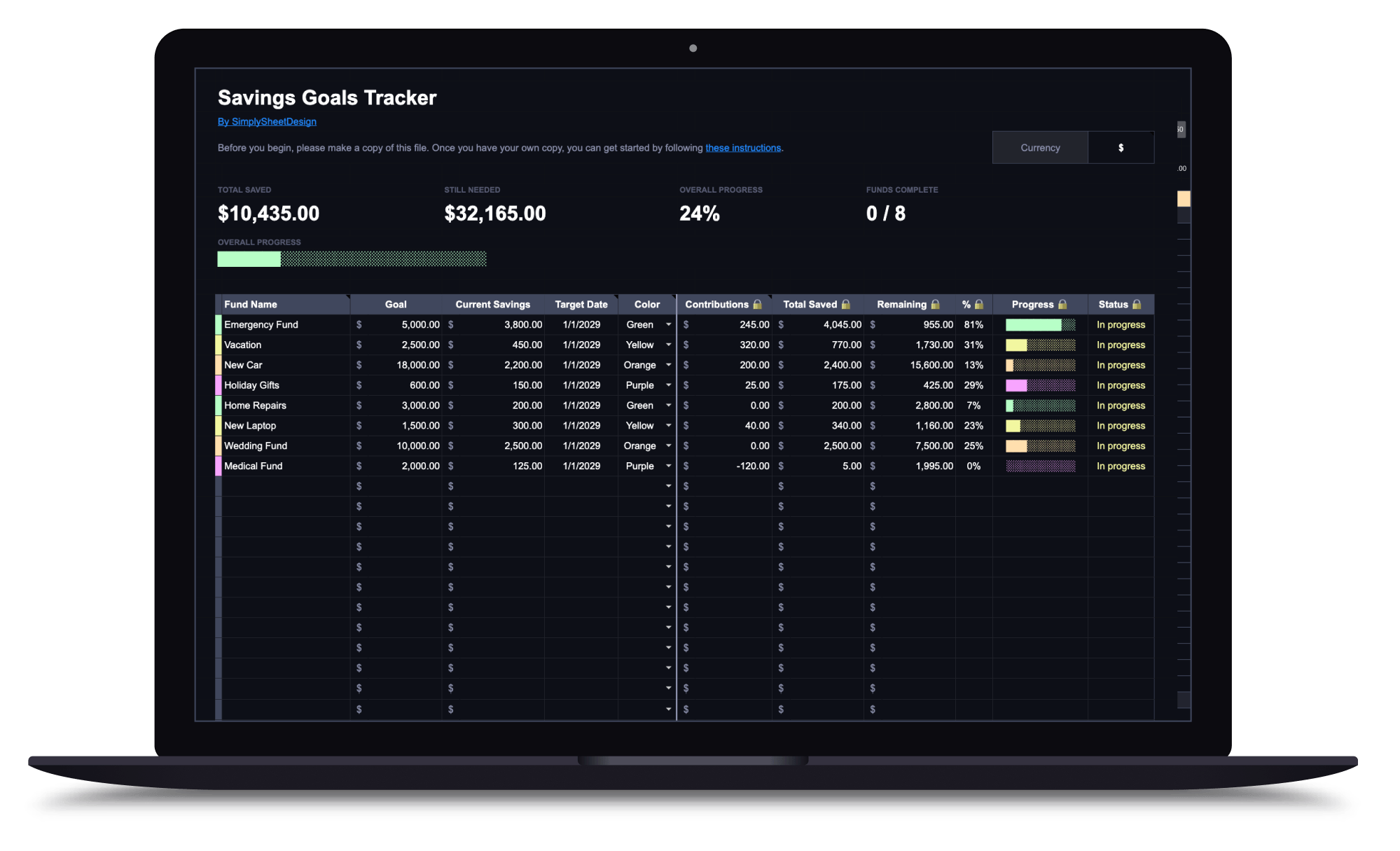
Track every fund in one place
Savings Goals Tracker
Set multiple savings goals, track contributions, and watch your progress toward each one. Perfect for emergency funds, sinking funds, and any savings target.